The Whitemarsh Art Center enriches the community by fostering inspiration, appreciation and engagement in the arts for people of all ages and abilities.
Our History
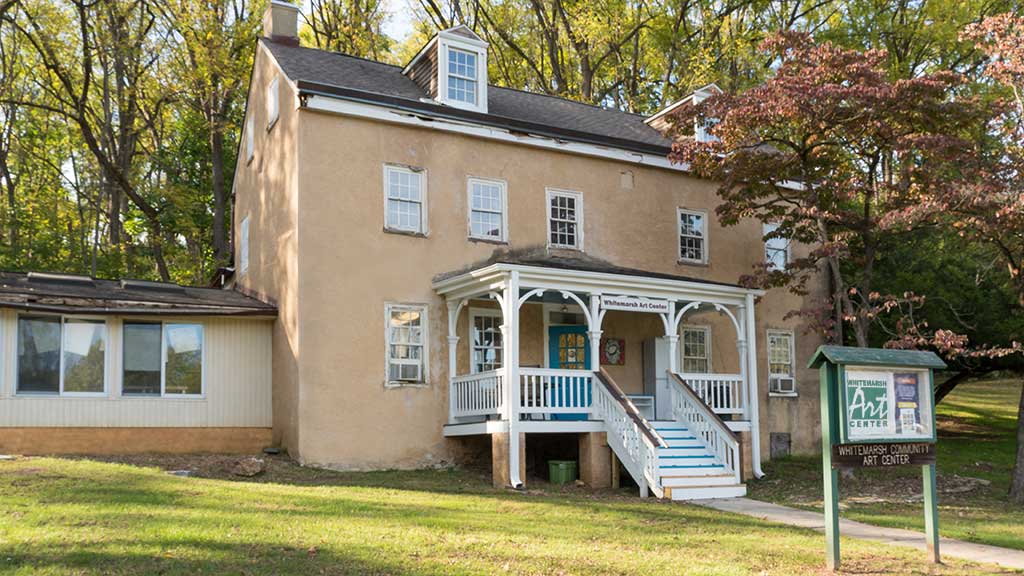
In 1964, the Whitemarsh Art Center began its humble journey in the home of Dena Sher, with the crucial support of Dorothy Nofer and Julia Cottrell. Its initial mission was focused on providing essential after-school arts programming for children. However, this children-exclusive focus quickly broadened to offer a diverse array of classes for all ages and experience levels. After years of sustained growth and increasing support from Whitemarsh Township, the Art Center relocated in 1970 to its long-established, historic home: a 1730 farmhouse situated in Cedar Grove Park. Early offerings expanded to include dance and meditation, often held in the historic barn next door—a space that remains vital for our larger workshops and special events today.
The original 400-square-foot farmhouse underwent a significant expansion in 1991. This project, which included the construction of the space known as the "Potting Shed," was spearheaded by President Helene Jaspan and the Art Center’s esteemed founder and art director, Julia Cottrell, who served as a constant presence and leader for many years. Helene Jaspan was instrumental in securing vital governmental assistance with the help of State Representative Lita Cohen. Today, the Art Center operates as a 501(c)(3) not-for-profit corporation. It is guided by a membership-based Board of Directors who provide vision, policy guidance, financial oversight and promotion. The dedication of countless volunteers has been, and continues to be, vital in making the Art Center an ongoing and treasured asset to our community.
Who We Are
The Whitemarsh Art Center is built on a foundation of community spirit, driven by the invaluable contributions of our volunteers. Together with our wonderful staff and inspiring teachers, we create a nurturing environment where our talented artists can explore, learn, and grow, making each class experience truly enriching.
The Whitemarsh Art Center provides both day and evening programming for children and adults. Our children's mixed-media classes offer a safe and engaging environment to explore clay, paint, drawing, and sculpture. These classes utilize diverse mediums like collage and printmaking while demonstrating art as the practical application of S.T.E.M. concepts. The Art Center also offers a children's summer art camp for students aged 6–10.
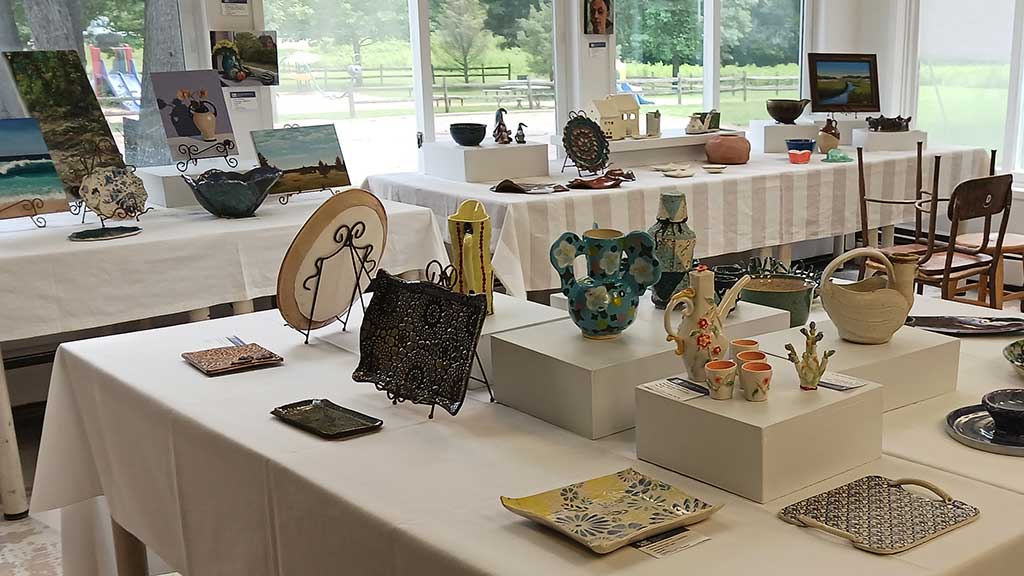
Our adult classes concentrate on clay, encompassing functional and sculptural pieces created through wheel throwing and hand-building techniques. Painting classes are available for all levels, from beginners to experienced artists. Additionally, we offer workshops in a variety of other mediums, including bookmaking, drawing, jewelry, sculpture, and printmaking.
Cultivating Humanity Through S.T.E.A.M.
At the Whitemarsh Art Center, we believe in the power of art to foster essential human qualities: creativity, empathy, innovation, and personal expression. Through artistic exploration, our students learn to observe with greater nuance, to experiment without fear of failure, and to translate their inner world into tangible forms, developing a deeper understanding of themselves and their place in the world
By integrating the rigor of S.T.E.A.M. with the boundless potential of human creativity, we empower our artists to not only master skills but also to cultivate their humanity, fostering a deeper connection to themselves and the world around them.
Art is a powerful and tangible outcome of S.T.E.A.M. (Science, Technology, Engineering, Art, and Mathematics) principles. We believe that S.T.E.A.M. provides the essential tools – the scientific understanding of materials, the technological means of creation, the engineering principles of structure, and the mathematical foundations of form and pattern. Art, in this light, becomes the practical and expressive application of these vital disciplines.
Our classes actively engage with this concept, demonstrating how the properties of clay are rooted in chemistry, how the mechanics of a printing press involve engineering, how digital art utilizes technology, and how the principles of perspective draw upon mathematics. By exploring these connections, our students gain a deeper understanding of the world around them and develop crucial problem-solving and critical thinking skills.